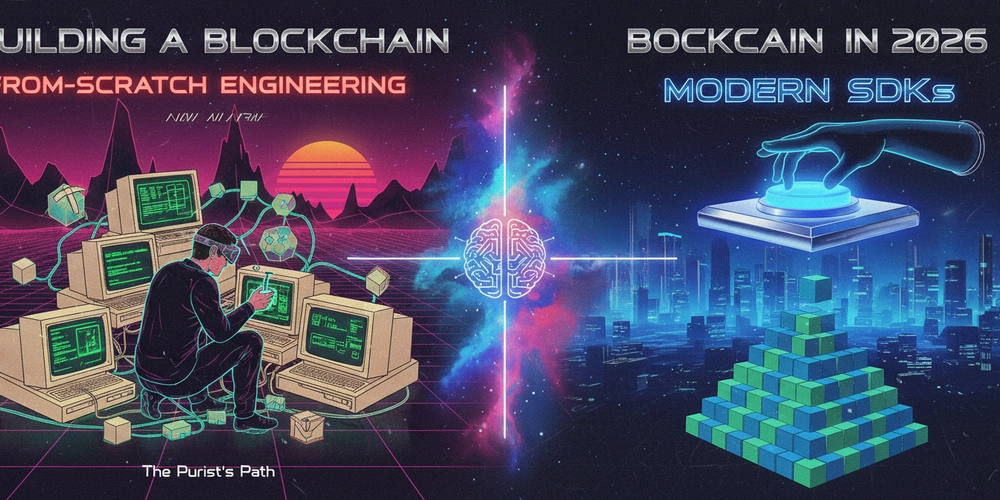
The blockchain ecosystem has evolved dramatically since Bitcoin’s launch in 2009. In the early years, designing a blockchain meant implementing every component yourself: networking, consensus, block validation, mining, difficulty adjustment, peer discovery, and wallet logic. Today, developers have access to mature frameworks such as Cosmos SDK, Substrate, Polygon CDK, and the OP Stack. These frameworks abstract many of the lower-level components, allowing teams to focus on business logic instead of reinventing infrastructure.
This raises an important question for engineers: Is it still worth building a blockchain entirely from scratch, like Bitcoin, or is relying on an SDK the practical approach in 2026?
This blog breaks down the engineering reality.
Many people think building a blockchain from scratch means creating new block types and hashing them. In reality, a “true from-scratch blockchain” requires implementing several subsystems:
1.1 Network Layer
Responsible for:
- Peer discovery
- Message propagation
- Gossip protocol
- Maintaining network topology
- Flood protection
- Peer scoring
- Bandwidth control
This layer alone can require months of engineering effort.
1.2 Consensus Algorithm
From scratch means you implement:
- Proof-of-Work or Proof-of-Stake logic
- Block proposal, voting, and finality
- Fork choice rules
- Difficulty or validator rotation
- Security assumptions
- Recovery logic
Bitcoin uses PoW with a simple longest-chain rule, while modern chains often use BFT-style consensus, which is significantly more complex.
1.3 Mempool & Transaction Lifecycle
You need to define:
- Transaction format
- Validation logic
- Prioritization rules
- Fee market design
- Relay policies
This becomes even more challenging if you support smart contracts.
1.4 State Machine
Either a:
- UTXO model (like Bitcoin)
- Account model (like Ethereum)
- Hybrid or custom model
State transition functions must be deterministic, secure, and efficient.
1.5 Cryptography
A custom chain requires decisions about:
- Signature schemes
- Hashing algorithms
- Merkle tree construction
- Key management
- Wallet compatibility
Bitcoin uses ECDSA secp256k1 and SHA-256 double hashing. Many chains today use Ed25519, BLS signatures, or STARK/STARK-friendly hash functions.
1.6 Storage & Database Layers
You must implement or integrate:
- Block storage
- Indexing
- State database
- Pruning
- Archival modes
Ethereum, for example, uses LevelDB/RocksDB with complex trie structures optimized over years.
1.7 Node Instrumentation
A production-grade blockchain node needs:
- RPC server
- WebSocket endpoints
- Debug API
- Logging and metrics
- Prometheus integration
- Monitoring and telemetry
Without these, external developers cannot build on your chain.
1.8 Wallet Infrastructure
You need to provide:
- Keypair generation
- Signing utilities
- Address formats
- Hardware wallet integrations
- Client libraries
Building a blockchain from scratch means building all of this.
It is fundamentally a distributed systems engineering project, not a Crypto Twitter idea.
Modern blockchain SDKs exist to save developers from rebuilding components that have already been solved millions of times.
A framework like Cosmos SDK or Substrate already includes:
- Peer-to-peer networking
- Production-tested consensus
- RPC and gRPC servers
- Modular governance
- IBC or cross-chain communication
- Staking and slashing
- WASM or EVM execution environments
- State management and storage layers
Using an SDK provides:
- Faster development times
- Safer consensus implementation
- Easier upgrades
- Existing toolchains
- Wallet compatibility
- Easier validator bootstrapping
Today, more than 90% of new blockchains are built on one of these frameworks. Entire L1 ecosystems such as Osmosis, Sei, Evmos, Injective, and dYdX are built using the Cosmos SDK.
The reason is simple: developers want to build chains, not reinvent distributed networking from scratch.
A common concern is:
“If I use Cosmos SDK or Substrate, am I dependent on their codebase?”
The truth is more nuanced. SDKs are open-source frameworks, not proprietary platforms.
You can:
- Fork the code
- Modify modules
- Replace consensus
- Build custom state machines
- Write new modules in Go or Rust
This is no different from building a web server on top of Linux instead of writing your own operating system.
You are not dependent; you are leveraging battle-tested engineering.
Despite the complexity, there are legitimate reasons to build your own blockchain from zero.
4.1 You are designing new consensus
For example:
- A novel PoW algorithm
- ASIC-resistant mining
- New BFT variants
- DAG-based systems
- Order-fairness consensus like Pulp Systems or Wimble
4.2 You need a fully custom architecture
Examples:
- Bitcoin’s UTXO model
- Nano’s block-lattice
- Kadena’s braided chains
- Solana’s proof-of-history timestamping
- Chia’s proof-of-space
4.3 You want full control of networking
Especially relevant for:
- IoT blockchains
- On-premises or air-gapped systems
- Ultra-low-latency trading chains
4.4 You are building a research chain or academic project
Building from scratch is the best way to understand blockchain internals at a low level.
4.5 You want to avoid existing technical debt
Some teams believe building a new stack is better than inheriting old architectural compromises.
But these are specific cases, not general needs.
For 99% of modern blockchain projects, the goal is:
- Launching a chain that supports smart contracts
- Providing cheap blockspace
- Enabling developers to build apps
- Creating custom tokenomics or modules
- Interoperability with other ecosystems
- Setting up validators and RPC infrastructure
If this describes your use case, writing your own P2P networking library or consensus engine provides no additional value.
The Priority in 2026 is:
Fewer teams care about reinventing block propagation.
They care about:
- throughput
- tooling
- developer experience
- stability
- interoperability
- predictable upgrades
And these are areas where SDKs excel.
If your goal is a production-grade chain, here are realistic numbers:
Team Requirement
- 3–6 core protocol engineers
- 2 distributed systems engineers
- 1–2 cryptographers
- 3 devops + SRE for network ops
- 2 QA engineers
- 1 project manager
- 1 documentation engineer
Timeframe
- Minimum 18–36 months for mainnet
- Additional 12 months for tooling, wallets, SDKs
Cost Breakdown
- Engineering salaries (core protocol): $2–5M
- Infrastructure (testnet & mainnet): $200k+
- Security audits: $300k–$1M
- Maintenance: ongoing costs
This is why frameworks dominate.
Not because developers are “lazy”, but because rebuilding the entire Bitcoin stack is prohibitively expensive unless you are innovating at the protocol level.
Many successful blockchains take an in-between approach:
- Use an SDK for networking and consensus
- Replace or extend the execution environment
- Write custom modules
- Write a custom mempool or fee mechanism
- Modify state machine logic
- Add their own governance logic
Examples:
- dYdX replaced CosmWasm with a custom Rust engine
- Celestia uses Cosmos SDK but created a new DA layer
- Aptos built a new VM but reused classical networking
- Arbitrum Orbit uses OP Stack + custom proving logic
- Sei modified mempool design for parallel execution
You avoid rewriting everything while still achieving deep differentiation.
Building a blockchain from scratch is technically possible and still relevant for certain categories of projects, particularly when designing novel consensus or architectures. However, in 2026, most blockchains do not need to reimplement Bitcoin’s network or Ethereum’s fundamental components. The ecosystem has matured to the point where leveraging frameworks is not a shortcut but an industry standard.
If your goal is to launch a secure, scalable chain with modern tooling, smart contract support, and interoperability, using a mature SDK is the effective path.
If your goal is fundamental protocol innovation or academic exploration, building from scratch remains a valuable pursuit.
The key question is not whether you can build a blockchain from scratch, but whether it is the best use of your engineering time in an ecosystem where mature, open-source frameworks already exist.